
오늘의 핵심 표현을 완성해 보세요!
단어를 탭해서 올바른 문장을 만들어 보세요!
선생님이 과제를 냈습니다.
Topic: your funniest or most embarrassing moment
with English since you arrived here. "
영자의 머릿속에 바로 떠올랐습니다.
발표 날.
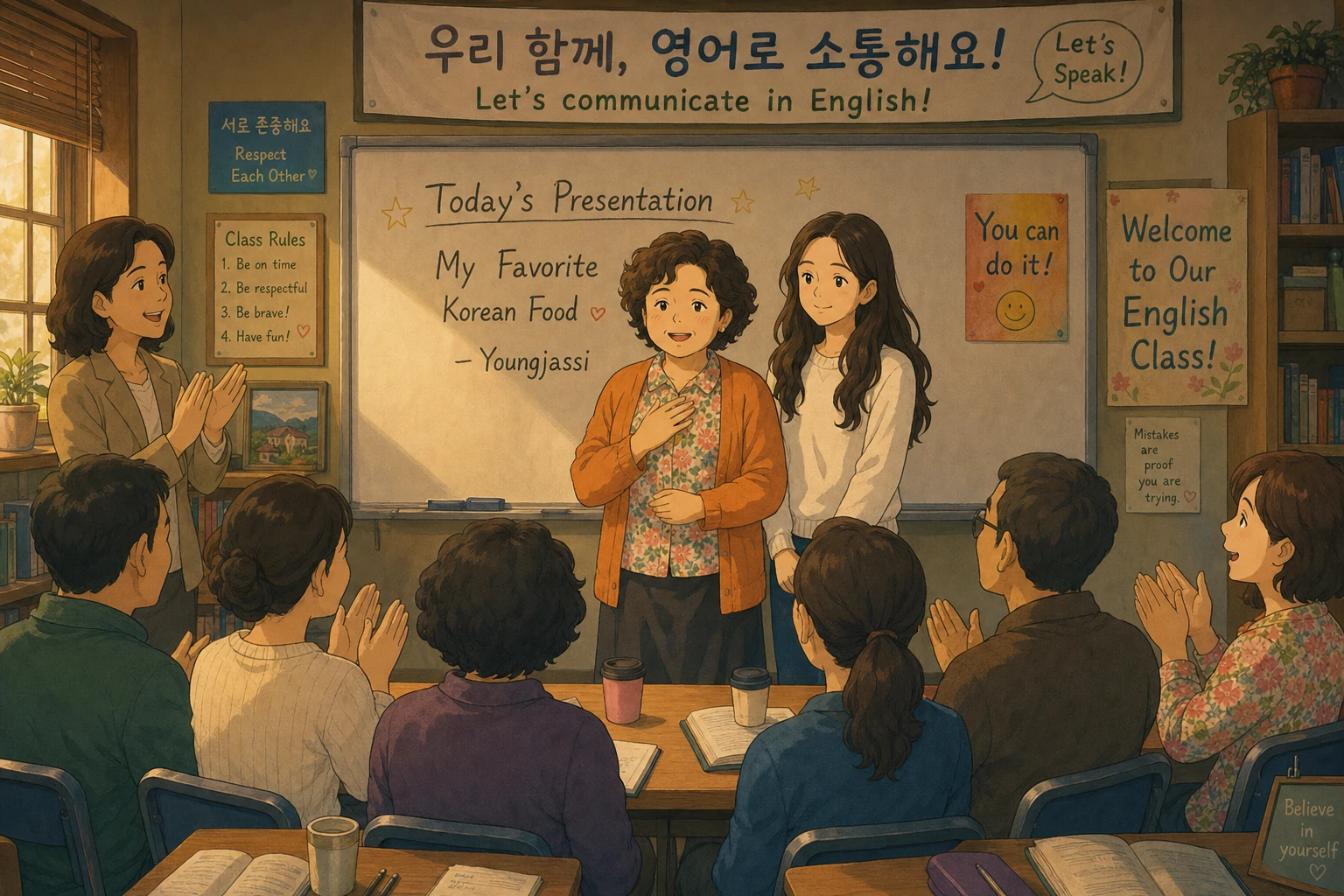
영자가 앞에 나갔습니다.
교실이 조용해졌습니다.
When she handed them to me, she said:
'You shouldn't have!'"
영자가 표정을 지었습니다 — 당황한 얼굴.
Did I say something bad? Did I break a rule?
I started to apologize. Many times.
'I am so sorry! I am so sorry! Please forgive me!'"
반 친구들이 웃기 시작했습니다.
Later my daughter explained.
'You shouldn't have' means — 'thank you so much for this gift.
You are too kind. You didn't need to do this.'
It is not a complaint. It is a compliment. "
영자가 두 손을 들었습니다.
I had apologized seventeen times to a woman
who was trying to thank me. "
교실이 웃음으로 가득 찼습니다.
I smile. Because that mistake is my teacher. "
박수가 터졌습니다.
선생님이 일어서서 박수를 쳤습니다.
Clear, honest, and genuinely funny.
And I want everyone to hear this:
the best way to learn a language is through laughter.
Young-ja just proved it. "
영자가 자리로 돌아오면서 Rosa가 속삭였습니다.
영자가 웃으며 말했습니다.
America gave me many, many mistakes to tell stories about. "
The teacher gives a homework assignment.
"Give a two-minute presentation about a funny English mistake."
Young-ja talks about "You shouldn't have."
She thought it was a complaint — but it means "thank you!"
She apologized seventeen times to her neighbor.
Her neighbor was confused. Young-ja was confused.
Later her daughter explained everything.
Now Young-ja laughs every time she hears it.
The class laughs and claps.
The teacher says, "The best way to learn is through laughter!"
Rosa whispers, "You are a natural storyteller."
Young-ja smiles. "America gave me good material!"
The teacher assigns a two-minute presentation about a funny English mistake.
Young-ja immediately knows her topic: "You shouldn't have."
On presentation day, she tells the story clearly:
Her neighbor handed her cookies and said "You shouldn't have!"
Young-ja panicked — she thought she had done something wrong.
She apologized seventeen times.
Her neighbor was confused. Young-ja was mortified.
Later her daughter explained: "You shouldn't have" is a compliment — it means "thank you, you're too kind."
Young-ja raises both hands: "I apologized seventeen times to someone thanking me."
The class roars with laughter.
The teacher stands and claps.
"The best way to learn a language is through laughter. Young-ja just proved it."
Rosa whispers: "You are a natural storyteller."
Young-ja smiles: "America gave me very good material."
"Next week," Ms. Rivera said, "each of you will give a two-minute presentation.
The topic: your funniest or most embarrassing moment with English since you arrived.
The goal is not perfection. The goal is honesty. "
Young-ja knew immediately.
You shouldn't have.
She had been saving that story for the right moment.
This was it.
Presentation day. Young-ja stood at the front of the room.
Seven faces looked at her. Ms. Rivera's pen was poised over her notepad.
"My topic today is: My Funniest English Mistake."
She paused — not from nerves, but for effect.
She had learned, somewhat accidentally, that timing mattered.
"Several months ago, my neighbor knocked on my door
and handed me a plate of cookies she had baked herself.
She placed them in my hands, looked at me warmly, and said —"
Young-ja replicated the neighbor's exact expression.
"'You shouldn't have!'"
She paused again.
"I froze. I thought: what did I do? What rule did I break?
Did I offend her? Is she angry? What is happening?
I put the cookies down — very carefully, as if they were evidence —
and I began to apologize. "
She counted on her fingers.
"I am sorry. I am so sorry. I apologize. I didn't mean to.
Please forgive me. It will not happen again.
I'm so, so sorry. "
The room was already laughing.
"My neighbor's face became — very confused.
She kept saying 'No no, it's fine!' But I kept apologizing.
I think I said sorry approximately seventeen times. "
The laughter got louder.
"That evening, I told my daughter.
She covered her face. "
Young-ja demonstrated — hands over face, shoulders shaking.
"Then she explained.
'You shouldn't have' in English means —
'Thank you. This gift was so kind. You didn't need to do this for me.'
It is a compliment. It is gratitude.
It sounds like a complaint. But it is the opposite. "
Young-ja spread her hands.
"I had spent forty minutes apologizing to a woman
who was trying to thank me for being a good neighbor. "
The room was fully laughing now — the warm, genuine laughter of people
who had all made versions of the same mistake.
"But now? Every single time I hear 'you shouldn't have' —
I smile. Because that mistake taught me more than any textbook page. "
She sat down.
Ms. Rivera began to applaud, slowly and deliberately.
The class followed.
"Young-ja," Ms. Rivera said, "that was clear, honest,
and — I need to be direct — genuinely funny.
The timing, the expressions, the build-up. "
She looked at the whole class.
"I want everyone to remember what we just witnessed.
The best way to learn a language is through laughter.
Not through fear of mistakes. Through laughter at them.
Young-ja just demonstrated this perfectly. "
Rosa leaned over and whispered,
"You are a natural storyteller, you know."
Young-ja considered this.
"I have good material," she said.
"America has been very generous with my mistakes."
The teacher gives a homework assignment.
"Give a two-minute presentation about a funny English mistake."
Young-ja talks about "You shouldn't have."
She thought it was a complaint — but it means "thank you!"
She apologized seventeen times to her neighbor.
Her neighbor was confused. Young-ja was confused.
Later her daughter explained everything.
Now Young-ja laughs every time she hears it.
The class laughs and claps.
The teacher says, "The best way to learn is through laughter!"
Rosa whispers, "You are a natural storyteller."
Young-ja smiles. "America gave me good material!"
The teacher assigns a two-minute presentation about a funny English mistake.
Young-ja immediately knows her topic: "You shouldn't have."
On presentation day, she tells the story clearly:
Her neighbor handed her cookies and said "You shouldn't have!"
Young-ja panicked — she thought she had done something wrong.
She apologized seventeen times.
Her neighbor was confused. Young-ja was mortified.
Later her daughter explained: "You shouldn't have" is a compliment — it means "thank you, you're too kind."
Young-ja raises both hands: "I apologized seventeen times to someone thanking me."
The class roars with laughter.
The teacher stands and claps.
"The best way to learn a language is through laughter. Young-ja just proved it."
Rosa whispers: "You are a natural storyteller."
Young-ja smiles: "America gave me very good material."
"Next week," Ms. Rivera said, "each of you will give a two-minute presentation.
The topic: your funniest or most embarrassing moment with English since you arrived.
The goal is not perfection. The goal is honesty. "
Young-ja knew immediately.
You shouldn't have.
She had been saving that story for the right moment.
This was it.
Presentation day. Young-ja stood at the front of the room.
Seven faces looked at her. Ms. Rivera's pen was poised over her notepad.
"My topic today is: My Funniest English Mistake."
She paused — not from nerves, but for effect.
She had learned, somewhat accidentally, that timing mattered.
"Several months ago, my neighbor knocked on my door
and handed me a plate of cookies she had baked herself.
She placed them in my hands, looked at me warmly, and said —"
Young-ja replicated the neighbor's exact expression.
"'You shouldn't have!'"
She paused again.
"I froze. I thought: what did I do? What rule did I break?
Did I offend her? Is she angry? What is happening?
I put the cookies down — very carefully, as if they were evidence —
and I began to apologize. "
She counted on her fingers.
"I am sorry. I am so sorry. I apologize. I didn't mean to.
Please forgive me. It will not happen again.
I'm so, so sorry. "
The room was already laughing.
"My neighbor's face became — very confused.
She kept saying 'No no, it's fine!' But I kept apologizing.
I think I said sorry approximately seventeen times. "
The laughter got louder.
"That evening, I told my daughter.
She covered her face. "
Young-ja demonstrated — hands over face, shoulders shaking.
"Then she explained.
'You shouldn't have' in English means —
'Thank you. This gift was so kind. You didn't need to do this for me.'
It is a compliment. It is gratitude.
It sounds like a complaint. But it is the opposite. "
Young-ja spread her hands.
"I had spent forty minutes apologizing to a woman
who was trying to thank me for being a good neighbor. "
The room was fully laughing now — the warm, genuine laughter of people
who had all made versions of the same mistake.
"But now? Every single time I hear 'you shouldn't have' —
I smile. Because that mistake taught me more than any textbook page. "
She sat down.
Ms. Rivera began to applaud, slowly and deliberately.
The class followed.
"Young-ja," Ms. Rivera said, "that was clear, honest,
and — I need to be direct — genuinely funny.
The timing, the expressions, the build-up. "
She looked at the whole class.
"I want everyone to remember what we just witnessed.
The best way to learn a language is through laughter.
Not through fear of mistakes. Through laughter at them.
Young-ja just demonstrated this perfectly. "
Rosa leaned over and whispered,
"You are a natural storyteller, you know."
Young-ja considered this.
"I have good material," she said.
"America has been very generous with my mistakes."
"오늘 제 주제는 가장 재미있는 영어 실수예요."를 영어로 만들어보세요!
왼쪽 영어를 클릭 → 오른쪽 한국어를 클릭!
왼쪽엔 오늘 수업, 오른쪽엔 ChatGPT가 열립니다.