
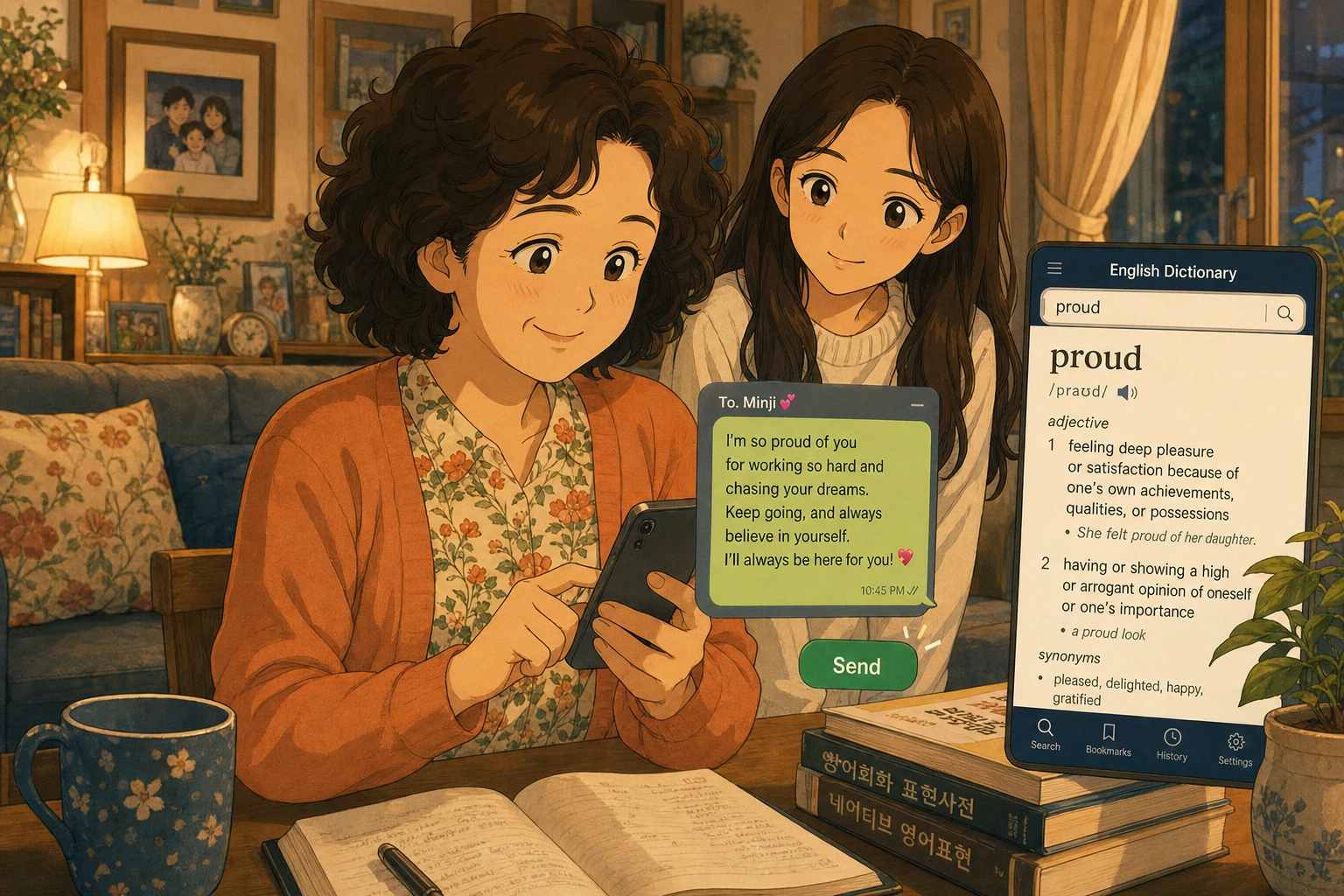
오늘의 핵심 표현을 완성해 보세요!
단어를 탭해서 올바른 문장을 만들어 보세요!
영자는 매일 아침 딸에게 영어 문자를 보내기 시작했습니다.
딸이 말했습니다.
오늘 문자:
Today I cook bibimbap for Linda.
She love it very much. She say 'Oh my goodness, incredible!'
Weather is nice. I walk in park one hour.
I see two ducks at pond. Very cute.
See you at dinner. Love you. "
딸이 답했습니다.
P. S. — 'she loves' not 'she love.'
He/she/it → always add S!
But I understood every single word perfectly. 🥰"
영자가 읽으며 웃었습니다.
그리고 답했습니다.
She LOVES it. She LOVES bibimbap. She LOVES everything I cook!
I will remember. He/she/it + S.
P. S. I loves you. "
딸이 세 개의 점이 뜨더니 답했습니다.
I loves you too, Mom. 💕"
영자가 핸드폰을 내려놓으며 웃었습니다.
내 영어가 이상해도.
딸이 항상 이해해줘.
그리고 항상 고쳐줘.
그리고 항상 웃어줘.
이보다 더 좋은 선생님은 없어. "
영자가 노트에 썼습니다.
She loves (O)
She love (X)
I loves — 딸이 봐준다 ^^"
Young-ja sends her daughter an English text every day.
Today's text: "I cook bibimbap for Linda. She love it very much."
Her daughter answers: "She LOVES — not 'she love'! He/she/it always needs S!"
Young-ja thanks her and writes back:
"She LOVES it! She LOVES my cooking!
P. S. I loves you. "
Her daughter replies: "I loves you too, Mom! 😂"
Young-ja laughs and writes in her notebook:
"He/she/it → add S. Always."
Young-ja has started a new habit — one English text to her daughter every morning.
Today's text talks about cooking bibimbap for Linda,
walking in the park, and seeing two cute ducks.
Her daughter responds: "Mom — your English texts are the best part of my day!
P. S. 'She loves' — not 'she love.' He/she/it always needs S. "
Young-ja is happy to be corrected.
She writes back immediately:
"Thank you! She LOVES it. She LOVES bibimbap. She LOVES everything!
P. S. I loves you. "
Her daughter sends laughing emojis.
"That one I'll let slide. I loves you too, Mom! 💕"
Young-ja writes in her notebook:
"He/she/it → S. She loves (O). She love (X).
I loves — daughter lets it slide. ^^"
The habit had started three weeks ago, after her daughter mentioned offhandedly:
"Mom, why don't you send me an English text every day? Even just a few sentences.
It's good practice and I like knowing what you're up to. "
Young-ja had taken this seriously.
Every morning, after her coffee, she composed the day's text.
She wrote it in her notebook first, then typed it into the phone.
Sometimes she deleted and rewrote three times.
Sometimes it came out in one go.
Today's text had taken about four minutes:
"Hi daughter.
Today I cook bibimbap for Linda.
She love it very much. She say 'Oh my goodness, this is incredible!'
I am very happy.
Weather is nice today. I walk in park one hour.
I see two ducks at the pond. Very cute.
See you at dinner time. Love you. "
She pressed send and made herself a cup of tea.
Twenty minutes later, her phone buzzed.
"MOM. Your English texts are genuinely the best part of my entire day.
Every single one.
P. S. — 'She loves,' not 'she love.' When the subject is he, she, or it,
the verb needs an S in present tense. Third person singular — always add S!
But I understood every word perfectly and the duck detail was extremely important. 🥰"
Young-ja read this twice. Then set the phone down. Then picked it up again.
She typed back slowly and carefully.
"Thank you for the correction.
She LOVES it. She LOVES bibimbap.
She LOVES everything that I cook, which is correct and also true.
I will remember: he/she/it + S. Always.
P. S. I loves you. "
She pressed send.
Then looked at what she had written.
Left it.
Three dots appeared. Then:
"😂😂😂 THAT ONE I am officially letting slide.
Grammar rule suspended for: 'I loves you, Mom.'
I loves you too. 💕"
Young-ja put the phone on the table and laughed out loud in the empty apartment.
She opened her small grammar notebook — the one she had started carrying
since the English class began — and wrote:
He / she / it → 동사에 S 붙이기 (3인칭 단수 현재형)
She loves ✅
She love ✗
I loves → 딸이 봐준다. 규칙 잠정 정지. ^^
She thought about what her daughter had said.
"The best part of my entire day."
Not the work emails. Not the meetings.
Her mother's imperfect English texts about bibimbap and ducks.
Young-ja picked up the phone and looked at tomorrow's weather forecast.
Partly cloudy. Possible wind.
She was already composing the next text in her head.
Young-ja sends her daughter an English text every day.
Today's text: "I cook bibimbap for Linda. She love it very much."
Her daughter answers: "She LOVES — not 'she love'! He/she/it always needs S!"
Young-ja thanks her and writes back:
"She LOVES it! She LOVES my cooking!
P. S. I loves you. "
Her daughter replies: "I loves you too, Mom! 😂"
Young-ja laughs and writes in her notebook:
"He/she/it → add S. Always."
Young-ja has started a new habit — one English text to her daughter every morning.
Today's text talks about cooking bibimbap for Linda,
walking in the park, and seeing two cute ducks.
Her daughter responds: "Mom — your English texts are the best part of my day!
P. S. 'She loves' — not 'she love.' He/she/it always needs S. "
Young-ja is happy to be corrected.
She writes back immediately:
"Thank you! She LOVES it. She LOVES bibimbap. She LOVES everything!
P. S. I loves you. "
Her daughter sends laughing emojis.
"That one I'll let slide. I loves you too, Mom! 💕"
Young-ja writes in her notebook:
"He/she/it → S. She loves (O). She love (X).
I loves — daughter lets it slide. ^^"
The habit had started three weeks ago, after her daughter mentioned offhandedly:
"Mom, why don't you send me an English text every day? Even just a few sentences.
It's good practice and I like knowing what you're up to. "
Young-ja had taken this seriously.
Every morning, after her coffee, she composed the day's text.
She wrote it in her notebook first, then typed it into the phone.
Sometimes she deleted and rewrote three times.
Sometimes it came out in one go.
Today's text had taken about four minutes:
"Hi daughter.
Today I cook bibimbap for Linda.
She love it very much. She say 'Oh my goodness, this is incredible!'
I am very happy.
Weather is nice today. I walk in park one hour.
I see two ducks at the pond. Very cute.
See you at dinner time. Love you. "
She pressed send and made herself a cup of tea.
Twenty minutes later, her phone buzzed.
"MOM. Your English texts are genuinely the best part of my entire day.
Every single one.
P. S. — 'She loves,' not 'she love.' When the subject is he, she, or it,
the verb needs an S in present tense. Third person singular — always add S!
But I understood every word perfectly and the duck detail was extremely important. 🥰"
Young-ja read this twice. Then set the phone down. Then picked it up again.
She typed back slowly and carefully.
"Thank you for the correction.
She LOVES it. She LOVES bibimbap.
She LOVES everything that I cook, which is correct and also true.
I will remember: he/she/it + S. Always.
P. S. I loves you. "
She pressed send.
Then looked at what she had written.
Left it.
Three dots appeared. Then:
"😂😂😂 THAT ONE I am officially letting slide.
Grammar rule suspended for: 'I loves you, Mom.'
I loves you too. 💕"
Young-ja put the phone on the table and laughed out loud in the empty apartment.
She opened her small grammar notebook — the one she had started carrying
since the English class began — and wrote:
He / she / it → 동사에 S 붙이기 (3인칭 단수 현재형)
She loves ✅
She love ✗
I loves → 딸이 봐준다. 규칙 잠정 정지. ^^
She thought about what her daughter had said.
"The best part of my entire day."
Not the work emails. Not the meetings.
Her mother's imperfect English texts about bibimbap and ducks.
Young-ja picked up the phone and looked at tomorrow's weather forecast.
Partly cloudy. Possible wind.
She was already composing the next text in her head.
"he/she/it 다음에는 항상 동사에 S를 붙여요."를 영어로 만들어보세요!
왼쪽 영어를 클릭 → 오른쪽 한국어를 클릭!
왼쪽엔 오늘 수업, 오른쪽엔 ChatGPT가 열립니다.