
모든 훈련이 이 순간을 위한 것이었습니다. T-Minus 10부터 카운트다운! 점화, 발사, 궤도 진입 — 모든 것을 영어로 보고합니다.
Today is Step 9.
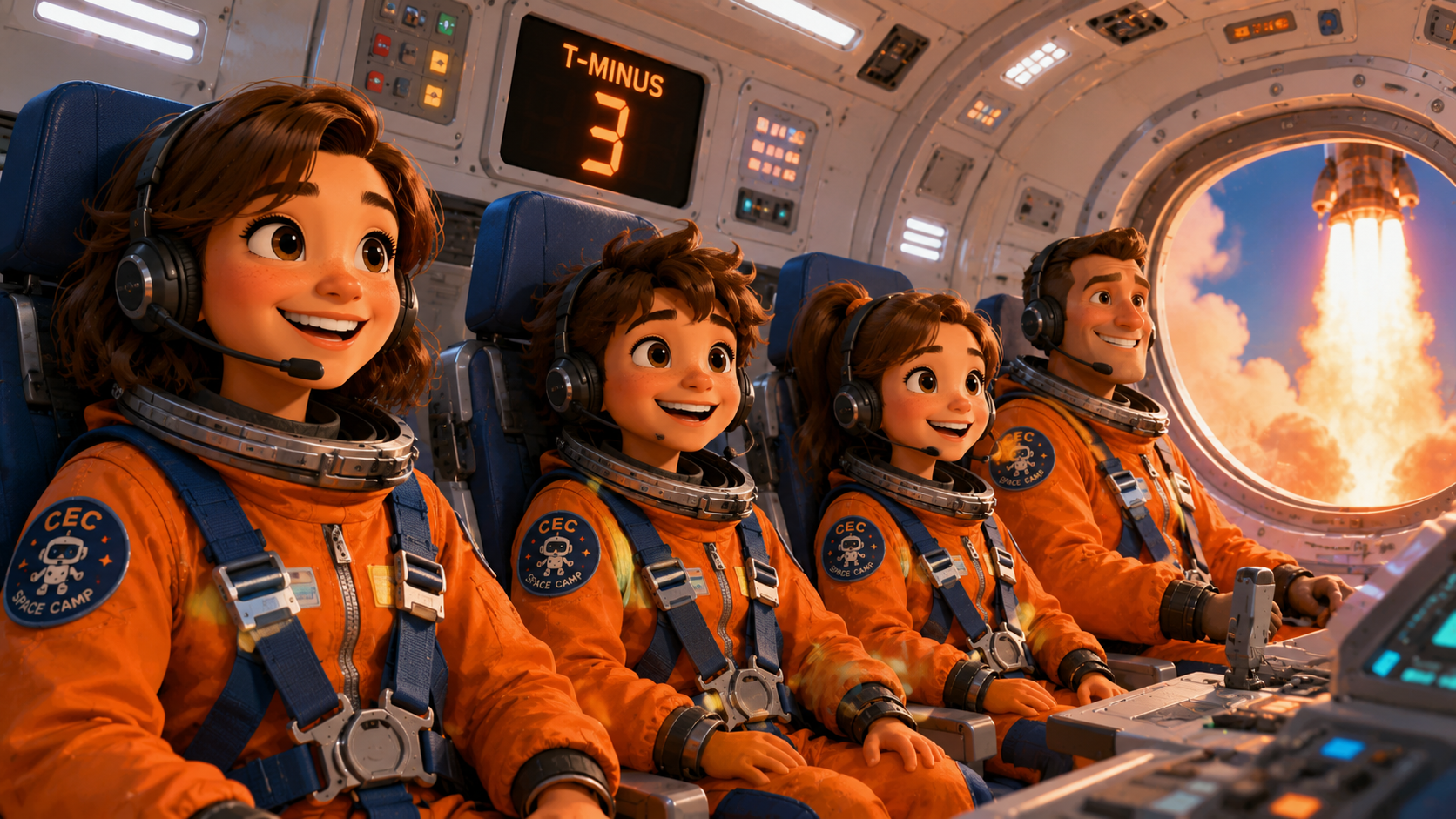
The trainees are ready for launch!
They sit in their seats. Their harnesses are on.
The countdown begins!
10... 9... 8... 7... 6... 5... 4... 3... 2... 1...
Ignition! We have liftoff!
The rocket goes up! Up! Up!
It breaks through the clouds.
Mission Control says:
"All systems nominal! You are GO for orbit!"
The crew reports:
"Mission Control! We are in orbit! Over!"
The trainees smile.
They did it! They are in space!
오늘은 9단계입니다.
훈련생들이 발사 준비를 마쳤습니다!
좌석에 앉고, 하네스를 착용합니다. 카운트다운이 시작됩니다!
10... 9... 8... 7... 6... 5... 4... 3... 2... 1...
점화! 발사 성공!
로켓이 올라갑니다! 위로! 위로! 구름을 뚫고 올라갑니다.
관제센터가 말합니다.
"모든 시스템 정상! 궤도 진입 준비 완료!"
크루가 보고합니다.
"관제센터! 궤도 진입 완료! 이상!"
훈련생들이 웃습니다. 해냈습니다! 우주에 있습니다!
In Step 9, trainees experience a launch simulation.
A launch simulation is a full practice of the rocket launch sequence.
Everything from the countdown to orbit insertion is practiced in the correct order.
The sequence begins at T-Minus 10.
This means 10 seconds before launch.
"T-Minus" is the term for counting down to launch time.
At T-Minus 10, the crew reports: "T-Minus 10. All systems go for launch!"
At T-Minus 3, the harness is checked one final time.
At T-Minus 1, the engines reach full power.
Then: "3... 2... 1... Ignition! We have liftoff!"
As the rocket climbs, Mission Control monitors every system.
They confirm: "Trajectory nominal. All systems green. GO for orbit!"
When the spacecraft reaches orbit, the crew makes the final report:
"Mission Control, this is CEC Space Camp crew. We have achieved orbit! All crew safe. All systems nominal. Over!"
9단계에서 훈련생들은 발사 시뮬레이션을 경험합니다.
발사 시뮬레이션은 로켓 발사 시퀀스의 전체 연습입니다.
카운트다운부터 궤도 진입까지 올바른 순서로 연습합니다.
시퀀스는 T-마이너스 10에서 시작합니다.
이것은 발사 10초 전을 의미합니다.
T-마이너스 10에서 크루가 보고합니다.
"T-마이너스 10. 모든 시스템 발사 준비 완료!"
그리고: "3! 2! 1! 점화! 발사 성공!"
로켓이 올라가면서 관제센터가 모든 시스템을 모니터링합니다.
"궤도 경로 정상. 모든 시스템 이상 없음. 궤도 진입 허가!"
우주선이 궤도에 도달하면 크루가 최종 보고를 합니다.
"관제센터, 여기는 CEC 스페이스 캠프 크루. 궤도 진입 완료! 전 승무원 안전. 모든 시스템 정상. 이상!"
A rocket launch is one of the most complex and dangerous events in human spaceflight.
Every second from ignition to orbit insertion must be precisely planned and executed.
The launch countdown begins at T-Minus 10.
Each step in the countdown has a specific purpose:
At T-10, final system confirmations are completed.
At T-5, the main engines begin their ignition sequence.
At T-3, crew performs a final harness verification.
At T-1, engines reach maximum thrust.
At T-0: ignition — the engines fire at full power, and the rocket lifts off the launch pad.
During the first phase of flight, the rocket passes through max-Q — the point of maximum aerodynamic pressure.
The engines throttle down briefly to reduce structural stress, then increase thrust again.
At approximately 8 minutes after liftoff, MECO (Main Engine Cutoff) occurs.
The main engines shut down, and the second stage separates.
The spacecraft then performs an insertion burn to enter the correct orbital path.
Once orbit is confirmed, the crew reports:
"Mission Control, orbit insertion complete. Apogee altitude nominal. All systems operational. We are GO for mission objectives. Over."
The launch simulation teaches trainees that spaceflight is not just about power — it is about precision, timing, and teamwork at every stage.
로켓 발사는 인류 우주비행에서 가장 복잡하고 위험한 사건 중 하나입니다.
점화부터 궤도 진입까지 매 초가 정밀하게 계획되고 실행되어야 합니다.
발사 카운트다운은 T-마이너스 10에서 시작됩니다.
T-10: 최종 시스템 확인. T-5: 주엔진 점화 시퀀스 시작.
T-3: 크루 하네스 최종 검증. T-1: 엔진 최대 추력 도달.
T-0에서 점화 — 엔진이 전력으로 가동되고 로켓이 발사대에서 이륙합니다.
비행 첫 단계에서 로켓은 max-Q를 통과합니다 — 최대 공기역학적 압력 지점입니다.
구조적 스트레스를 줄이기 위해 엔진이 잠시 감속한 후 다시 추력을 높입니다.
이륙 약 8분 후 MECO(주엔진 연소 종료)가 발생합니다.
주엔진이 꺼지고 2단 분리가 이루어집니다.
발사 시뮬레이션이 훈련생들에게 가르치는 것은 우주비행이 단순히 힘에 관한 것이 아니라는 점입니다.
모든 단계에서의 정확성, 타이밍, 팀워크에 관한 것입니다.