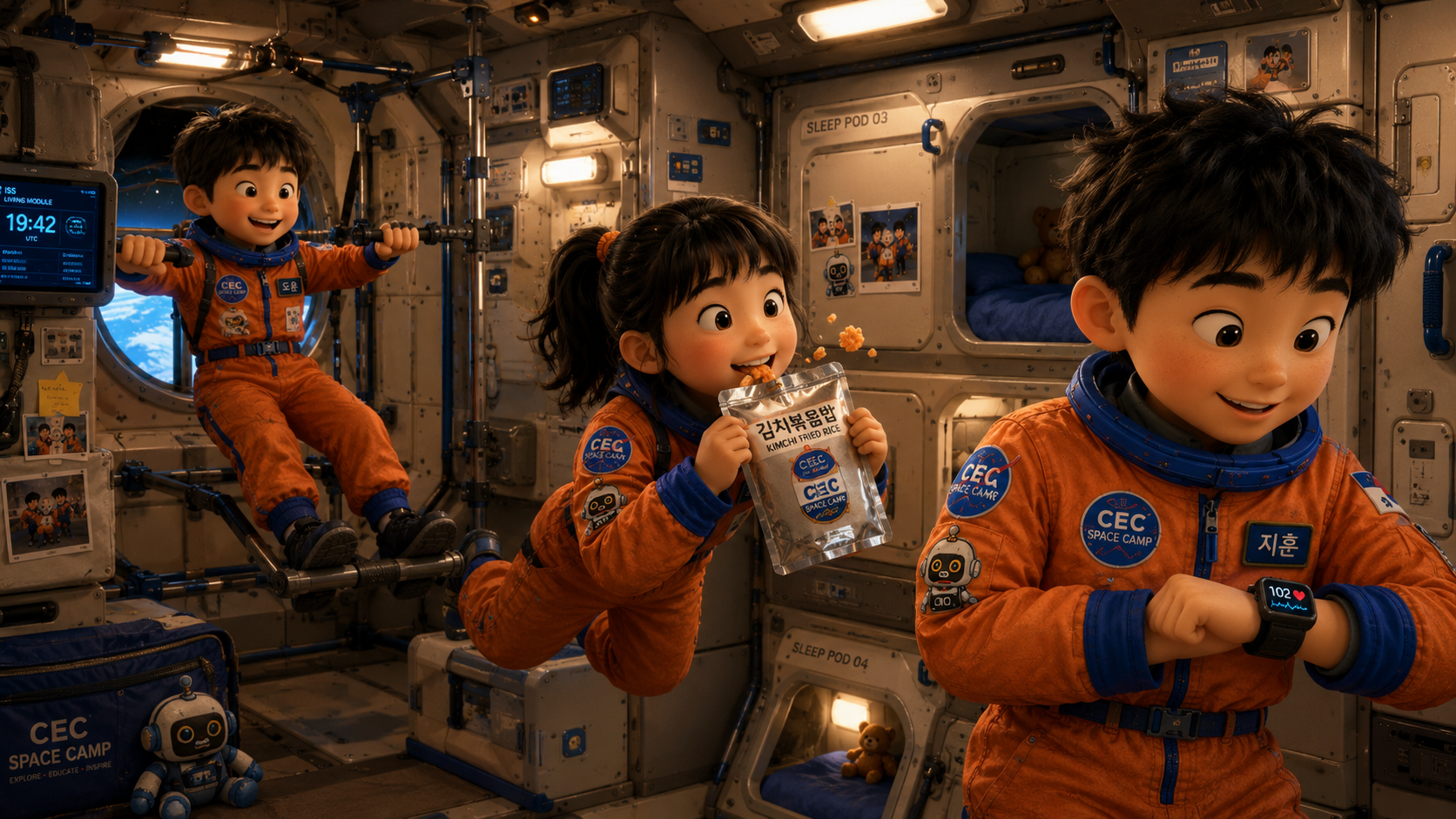
Space Life and Medical Check
SPACE LIFE Β· WEEK 3
STEP 15 / 20 β€” WEEK 3

ISS Docking
Training

μš°μ£Όμƒν™œκ³Ό 건강 체크

μš°μ£Όμ—μ„œμ˜ ν•˜λ£¨! μš΄λ™, κΉ€μΉ˜λ³ΆμŒλ°₯ 식사, 수면, 건강 μ²΄ν¬κΉŒμ§€ β€” μš°μ£Όμ—μ„œλ„ κ±΄κ°•ν•œ μƒν™œ 루틴이 μž„λ¬΄ μ„±κ³΅μ˜ μ—΄μ‡ μž…λ‹ˆλ‹€.

β–Έ 였늘의 핡심 ν‘œν˜„ 4κ°€μ§€
01
"Exercise complete. Heart rate nominal. Ready for next task."
μš΄λ™ μ™„λ£Œ. μ‹¬λ°•μˆ˜ 정상. λ‹€μŒ μž„λ¬΄ μ€€λΉ„ μ™„λ£Œ.
02
"Meal time. Today's menu: Kimchi Fried Rice. Enjoying in space!"
식사 μ‹œκ°„. 였늘 메뉴: κΉ€μΉ˜λ³ΆμŒλ°₯. μš°μ£Όμ—μ„œ λ§›μžˆκ²Œ!
03
"Sleeping bag secured. Good night from 400 kilometers above Earth."
μŠ¬λ¦¬ν•‘ λ°± κ³ μ • μ™„λ£Œ. 지ꡬ 400km μƒκ³΅μ—μ„œ κ΅Ώλ‚˜μž‡.
04
"Medical check complete. Heart rate 72. Oxygen 98%. Status: Nominal."
건강 체크 μ™„λ£Œ. μ‹¬λ°•μˆ˜ 72. μ‚°μ†Œ 98%. μƒνƒœ: 정상.
β–Έ μš°μ£Όμƒν™œμ˜ 3λŒ€ 원칙
SPACE LIFE RULES
πŸ’ͺ
EXERCISE DAILY
맀일 μš΄λ™
무쀑λ ₯μ—μ„œλŠ” 근윑이 λΉ λ₯΄κ²Œ μ•½ν•΄μ§‘λ‹ˆλ‹€. ν•˜λ£¨ 2μ‹œκ°„ μš΄λ™μ€ ν•„μˆ˜μž…λ‹ˆλ‹€.
🍱
EAT & HYDRATE
식사와 μˆ˜λΆ„ 보좩
밀봉 팩 μŒμ‹μ„ κ·œμΉ™μ μœΌλ‘œ μ„­μ·¨ν•˜κ³  μΆ©λΆ„ν•œ μˆ˜λΆ„μ„ μœ μ§€ν•˜μ„Έμš”.
❀️
HEALTH CHECK
건강 체크
맀일 μ‹¬λ°•μˆ˜, μ‚°μ†Œ 포화도, μ»¨λ””μ…˜μ„ μ²΄ν¬ν•˜κ³  Mission Control에 λ³΄κ³ ν•˜μ„Έμš”.
β–Έ 였늘의 ν›ˆλ ¨ 일정
MISSION TIME 25MIN
5λΆ„
STEP 15 VIDEO
STEP 15 μ˜μƒ μ‹œμ²­ β€” EVA 도ꡬ μ’…λ₯˜μ™€ νƒœμ–‘κ΄‘ νŒ¨λ„ 수리 μž₯면을 ν™•μΈν•©λ‹ˆλ‹€.
8λΆ„
VOCAB + PHRASES
핡심 μ–΄νœ˜μ™€ 일상 보고 ν‘œν˜„ 4κ°€μ§€λ₯Ό μ†Œλ¦¬ λ‚΄μ–΄ μ—°μŠ΅ν•©λ‹ˆλ‹€.
7λΆ„
READING
학년별 리딩 지문을 읽고 체크 ν€΄μ¦ˆμ— λ‹΅ν•©λ‹ˆλ‹€.
5λΆ„
GPT MISSION
Camp A GPTμ—κ²Œ ν•˜λ£¨ 건강 μƒνƒœλ₯Ό μ˜μ–΄λ‘œ λ³΄κ³ ν•©λ‹ˆλ‹€.
β–Έ 학년별 μ–΄νœ˜ & ν™œλ™
01
exercise
μš΄λ™ν•˜λ‹€
"I exercise every day in space."
02
meal
식사
"Meal time! Kimchi Fried Rice!"
03
sleep
μžλ‹€, 수면
"I sleep in a sleeping bag."
04
heart rate
μ‹¬λ°•μˆ˜
"My heart rate is 72. Normal!"
05
healthy
κ±΄κ°•ν•œ
"Stay healthy in space!"
1
STEP 15 μ˜μƒ μ‹œμ²­
⏱ 5λΆ„
우주 μš΄λ™, 식사, 수면, 건강 체크 루틴을 ν™•μΈν•©λ‹ˆλ‹€.
2
일상 보고 μ—°μŠ΅
⏱ 10λΆ„
"Exercise complete! Meal time! Heart rate 72. Status: Nominal!" 일상 보고 μ—°μŠ΅.
3
Camp A GPT ꡐ신
⏱ 10λΆ„
GPTμ—κ²Œ 였늘의 건강 μƒνƒœ 보고 + κΈ°λ³Έ μ–΄νœ˜ 5개 λ§ν•˜κΈ°.
01
resistance exercise
μ €ν•­ μš΄λ™
"Resistance exercise prevents muscle loss."
02
rehydrate
μˆ˜λΆ„ λ³΄μΆ©ν•˜λ‹€
"Add water to rehydrate the food packet."
03
sleeping bag
μŠ¬λ¦¬ν•‘ λ°±
"Secure your sleeping bag to the wall."
04
heart rate
μ‹¬λ°•μˆ˜
"Heart rate: 72 BPM. Nominal."
05
oxygen saturation
μ‚°μ†Œ 포화도
"Oxygen saturation: 98 percent."
06
nominal
정상
"All vital signs nominal."
1
STEP 15 μ˜μƒ μ‹œμ²­
⏱ 5λΆ„
우주 μš΄λ™Β·μ‹μ‚¬Β·μˆ˜λ©΄Β·κ±΄κ°• 체크 4κ°€μ§€ 루틴을 νŒŒμ•…ν•©λ‹ˆλ‹€.
2
일일 루틴 λ‘€ν”Œλ ˆμ΄
⏱ 10λΆ„
μš΄λ™ μ™„λ£Œ β†’ 식사 보고 β†’ 수면 μ€€λΉ„ β†’ 건강 체크 λ‘€ν”Œλ ˆμ΄.
3
Camp A GPT ꡐ신
⏱ 10λΆ„
ν•˜λ£¨ 건강 수치(μ‹¬λ°•μˆ˜/μ‚°μ†Œ/μ»¨λ””μ…˜) μ˜μ–΄ 보고 + ν”Όλ“œλ°±.
01
muscle atrophy
근윑 μœ„μΆ•
"Microgravity causes muscle atrophy."
02
bone density
골밀도
"Exercise maintains bone density."
03
circadian rhythm
일주기 리듬
"ISS sees 16 sunrises β€” disrupts circadian rhythm."
04
fluid shift
체앑 이동
"Fluid shifts toward the head in microgravity."
05
vital signs
ν™œλ ₯ μ§•ν›„
"Report all vital signs to flight surgeon."
06
countermeasure
λŒ€μ‘μ±…
"Exercise is a key health countermeasure."
1
우주 건강 μœ„ν—˜ 뢄석
⏱ 8λΆ„
κ·Όμœ‘μœ„μΆ•Β·κ³¨λ°€λ„Β·μ²΄μ•‘μ΄λ™Β·μΌμ£ΌκΈ° 리듬 영ν–₯을 기술 μ–΄νœ˜λ‘œ μ„€λͺ….
2
의료 보고 μž‘μ„±
⏱ 9λΆ„
ν™œλ ₯ μ§•ν›„ 수치 + μš΄λ™ 기둝 + μ»¨λ””μ…˜ μ˜μ–΄ 의료 보고문 μž‘μ„±.
3
Camp A GPT 심화 ꡐ신
⏱ 8λΆ„
기술 μ–΄νœ˜ μ‚¬μš© ν’€ 건강 보고 + ν”Όλ‘œ+골밀도 μ €ν•˜ μ‹œλ‚˜λ¦¬μ˜€ λŒ€μ‘.
β–Έ CEC Camp A GPT ꡐ신 ν›ˆλ ¨
MISSION TIME 25MIN
πŸ₯
ν•˜λ£¨ 건강 μƒνƒœ 보고
Camp A GPTκ°€ Mission Control μ—­ν• λ‘œ 건강 체크 ν›ˆλ ¨μ„ μ§„ν–‰ν•©λ‹ˆλ‹€.
Exercise! Eat & Hydrate! Health Check! μš°μ£Όμƒν™œ 3원칙을 μ˜μ–΄λ‘œ λ³΄κ³ ν•˜μ„Έμš”!
β–Έ GRADE LEVEL
β–Έ CAMP A GPT ν”„λ‘¬ν”„νŠΈ 미리보기
정보λ₯Ό μž…λ ₯ν•˜λ©΄ ν”„λ‘¬ν”„νŠΈκ°€ 여기에 ν‘œμ‹œλ©λ‹ˆλ‹€...
πŸš€ CEC Camp A GPT μ—΄κΈ°
βœ… 볡사 μ™„λ£Œ!
β–Έ 평가 κΈ°μ€€
⭐
PASS
μš°μ£Όμƒν™œ 3원칙 + κΈ°λ³Έ 건강 보고
⭐⭐
GOOD
건강 수치 보고 + GPT ꡐ신
⭐⭐⭐
EXCELLENT
기술 μ–΄νœ˜ μ‚¬μš© + ν’€ 의료 체크 보고
β–Έ 였늘의 볡슡 과제
πŸ‡ΊπŸ‡Έ
λ―Έκ΅­ 원어민 5ν•™λ…„
⏱ μ•½ 1~1.5μ‹œκ°„
  • μš°μ£Όμƒν™œ 3원칙 + μ–΄νœ˜ 6개 μ•”κΈ° (20λΆ„)
  • 핡심 ν‘œν˜„ 4개 μ†Œλ¦¬ λ‚΄μ–΄ λ§ν•˜κΈ° (20λΆ„)
  • Camp A GPT 건강 μƒνƒœ 보고 (20λΆ„)
  • 내일: μ‹€μ œ ISS μš°μ£ΌλΉ„ν–‰μ‚¬ ν•˜λ£¨ 일과 μ˜μƒ 찾아보기 (10λΆ„)
πŸ‡°πŸ‡·
ν•œκ΅­ 5ν•™λ…„
⏱ μ•½ 2~2.5μ‹œκ°„
  • μ–΄νœ˜ 6개 + μš°μ£Όμƒν™œ 루틴 μ™„μ „ μ•”κΈ° (30λΆ„)
  • 핡심 ν‘œν˜„ 4개 μ™Έμš°κΈ° + μ‘μš© (40λΆ„)
  • Camp A GPT 정상+ν”Όλ‘œ+κ·Όμœ‘ν†΅ μ‹œλ‚˜λ¦¬μ˜€ (30λΆ„)
  • μ‹€μ œ ISS μš°μ£ΌλΉ„ν–‰μ‚¬ 건강 관리 μ‘°μ‚¬ν•˜κΈ° (20λΆ„)
β–Έ READING SECTION
μ§‘μ—μ„œ 혼자 μ—°μŠ΅
β–Έ 주제 질문 TOPIC QUESTION
Why is it important for astronauts to exercise every day in space?
μš°μ£ΌλΉ„ν–‰μ‚¬λ“€μ€ μ™œ μš°μ£Όμ—μ„œ 맀일 μš΄λ™μ„ ν•΄μ•Ό ν• κΉŒμš”?
πŸ“– Reading Passage β€” Grade 4

Today is Step 15. It is time to dock!

The ISS is floating in space.
Our spacecraft is getting closer.
We need to connect to it.

This is called docking.
Docking means connecting two spaceships together.

First, we train underwater.
The pool feels like space.
We learn to move slowly and carefully.

Then we fly to the ISS.
10... 9... 8... 3... 2... 1...
Contact! We are connected!

Docking complete. Welcome to the ISS!

μ˜€λŠ˜μ€ 11λ‹¨κ³„μž…λ‹ˆλ‹€. 도킹할 μ‹œκ°„μž…λ‹ˆλ‹€!

ISSκ°€ μš°μ£Όμ— λ– μžˆμŠ΅λ‹ˆλ‹€.
우리 μš°μ£Όμ„ μ΄ 점점 κ°€κΉŒμ›Œμ§€κ³  μžˆμŠ΅λ‹ˆλ‹€.
μ—°κ²°ν•΄μ•Ό ν•©λ‹ˆλ‹€.

이것을 도킹이라고 ν•©λ‹ˆλ‹€.
도킹은 두 μš°μ£Όμ„ μ„ μ„œλ‘œ μ—°κ²°ν•˜λŠ” κ²ƒμž…λ‹ˆλ‹€.

λ¨Όμ € μˆ˜μ€‘μ—μ„œ ν›ˆλ ¨ν•©λ‹ˆλ‹€.
수영μž₯은 μš°μ£Όμ™€ λΉ„μŠ·ν•˜κ²Œ λŠκ»΄μ§‘λ‹ˆλ‹€.
천천히 μ‹ μ€‘ν•˜κ²Œ μ›€μ§μ΄λŠ” 법을 λ°°μ›λ‹ˆλ‹€.

그런 λ‹€μŒ ISS둜 λ‚ μ•„κ°‘λ‹ˆλ‹€.
10... 9... 8... 3... 2... 1...
접촉! μ—°κ²°λμŠ΅λ‹ˆλ‹€!

도킹 μ™„λ£Œ. ISS에 μ˜€μ‹  것을 ν™˜μ˜ν•©λ‹ˆλ‹€!

πŸ“ Key Words
dock
λ„ν‚Ήν•˜λ‹€
connect
μ—°κ²°ν•˜λ‹€
approach
μ ‘κ·Όν•˜λ‹€
contact
접촉
carefully
μ‹ μ€‘ν•˜κ²Œ
complete
μ™„λ£Œν•˜λ‹€
❓ Check Questions
  1. What is docking?
  2. Where do astronauts train for docking?
  3. Why do they train underwater?
  4. What happens when the countdown reaches one?
πŸ—£οΈ Speak & Write
We are approaching the ISS!
Contact! We are connected!
Docking complete. Welcome to the ISS!
πŸ“– Reading Passage β€” Grade 5

In Step 15, the crew must dock with the International Space Station β€” the ISS.

Docking means connecting a spacecraft to the ISS while both are traveling at 28,000 kilometers per hour.
The docking port is only about 80 centimeters wide.
One small mistake can cause a crash.

Before the real mission, astronauts train in the Neutral Buoyancy Lab β€” a giant swimming pool at NASA.
In the pool, astronauts wear weighted spacesuits so they float in place β€” just like in space.
They practice moving slowly and working as a team, again and again.

During the real docking, the pilot watches the radar screen carefully.
The navigator calls out the distance: "Twenty meters... ten meters... five meters."
The pilot makes tiny adjustments β€” left, right, up, down β€” using small thrusters.

Then, at exactly the right moment:
Contact.
Latches lock. The spacecraft and the ISS are connected.

Mission Control announces: "Docking confirmed. Welcome to the ISS."
Slow. Steady. Precise. That is how astronauts dock in space.

11λ‹¨κ³„μ—μ„œ ν¬λ£¨λŠ” κ΅­μ œμš°μ£Όμ •κ±°μž₯(ISS)κ³Ό 도킹해야 ν•©λ‹ˆλ‹€.

도킹은 두 μš°μ£Όμ„ μ΄ λͺ¨λ‘ μ‹œμ† 28,000km둜 μ΄λ™ν•˜λ©΄μ„œ μ—°κ²°ν•˜λŠ” κ²ƒμž…λ‹ˆλ‹€.
도킹 ν¬νŠΈλŠ” μ•½ 80cm λ„ˆλΉ„μž…λ‹ˆλ‹€. μž‘μ€ μ‹€μˆ˜ ν•˜λ‚˜κ°€ μΆ©λŒμ„ μΌμœΌν‚¬ 수 μžˆμŠ΅λ‹ˆλ‹€.

μ‹€μ „ μž„λ¬΄ 전에 μš°μ£ΌλΉ„ν–‰μ‚¬λ“€μ€ 쀑립뢀λ ₯ μ‹€ν—˜μ‹€μ—μ„œ ν›ˆλ ¨ν•©λ‹ˆλ‹€ β€” NASA의 κ±°λŒ€ν•œ 수영μž₯μž…λ‹ˆλ‹€.
수영μž₯μ—μ„œ μš°μ£ΌλΉ„ν–‰μ‚¬λ“€μ€ λ¬΄κ²Œκ°€ μžˆλŠ” μš°μ£Όλ³΅μ„ μž…μ–΄ μ œμžλ¦¬μ— 뜨게 λ©λ‹ˆλ‹€ β€” μš°μ£Όμ²˜λŸΌμš”.
천천히 움직이고 νŒ€μœΌλ‘œ μΌν•˜λŠ” 법을 반볡 μ—°μŠ΅ν•©λ‹ˆλ‹€.

μ‹€μ œ 도킹 쀑에 νŒŒμΌλŸΏμ€ λ ˆμ΄λ” 화면을 주의 깊게 λ΄…λ‹ˆλ‹€.
λ„€λΉ„κ²Œμ΄ν„°κ°€ 거리λ₯Ό ν˜ΈμΆœν•©λ‹ˆλ‹€: "20λ―Έν„°... 10λ―Έν„°... 5λ―Έν„°."

그런 λ‹€μŒ μ •ν™•ν•œ μˆœκ°„μ—: 접촉.
잠금μž₯μΉ˜κ°€ κ±Έλ¦½λ‹ˆλ‹€. μš°μ£Όμ„ κ³Ό ISSκ°€ μ—°κ²°λ©λ‹ˆλ‹€.

λ―Έμ…˜ 컨트둀이 λ°œν‘œν•©λ‹ˆλ‹€: "도킹 확인. ISS에 μ˜€μ‹  것을 ν™˜μ˜ν•©λ‹ˆλ‹€."
천천히. μ•ˆμ •μ μœΌλ‘œ. μ •ν™•ν•˜κ²Œ. 그것이 μš°μ£Όμ—μ„œ λ„ν‚Ήν•˜λŠ” λ°©λ²•μž…λ‹ˆλ‹€.

πŸ“ Key Words
docking port
도킹 포트
neutral buoyancy
쀑립 λΆ€λ ₯
thruster
μΆ”μ§„κΈ°
latch
잠금μž₯치
precise
μ •ν™•ν•œ
navigator
항법사
adjustment
μ‘°μ •
❓ Check Questions
  1. What does "docking" mean?
  2. Why is docking so difficult in space?
  3. What is the Neutral Buoyancy Lab?
  4. What does the navigator do during docking?
  5. What happens when the latches lock?
πŸ—£οΈ Speak & Write
Docking port aligned. Approach authorized.
Speed nominal. Distance: ten meters. Stand by.
Contact confirmed. Latches engaged. Docking complete.
✏️ Short Writing β€” 3 sentences
Docking means ____. | Astronauts train in the Neutral Buoyancy Lab because ____. | During docking, slow movement is important because ____.
πŸ“– Reading Passage β€” Grade 6

Docking with the International Space Station is one of the most precise operations in human spaceflight.

The ISS orbits Earth at approximately 7.7 kilometers per second.
A visiting spacecraft must match this velocity exactly before attempting to dock.
This process β€” called orbital rendezvous β€” can take several hours of careful maneuvering.

The docking sequence itself follows strict phases.
Soft capture occurs when the docking ring makes initial contact and probe mechanisms engage.
Hard mate follows, as 12 structural latches lock the two vehicles together permanently.
Finally, pressurization equalizes air pressure in the connecting tunnel so astronauts can safely open the hatch.

To train for this sequence, NASA uses the Neutral Buoyancy Laboratory β€” a pool containing 23 million liters of water.
Full-scale ISS modules are submerged inside.
Astronauts in weighted spacesuits spend up to 6 hours at a time practicing each step underwater.

During actual docking, the crew monitors translational velocity (forward/backward movement) and rotational axes β€” pitch, yaw, and roll β€” simultaneously.
Any deviation beyond a few centimeters requires an immediate thruster correction or a complete docking abort.

The precision required is extraordinary.
Yet astronauts achieve successful docking again and again β€” because they prepare completely, communicate constantly, and trust each other absolutely.

κ΅­μ œμš°μ£Όμ •κ±°μž₯과의 도킹은 인λ₯˜ μš°μ£ΌλΉ„ν–‰μ—μ„œ κ°€μž₯ μ •λ°€ν•œ μž‘μ—… 쀑 ν•˜λ‚˜μž…λ‹ˆλ‹€.

ISSλŠ” μ΄ˆλ‹Ή μ•½ 7.7km μ†λ„λ‘œ 지ꡬλ₯Ό κ³΅μ „ν•©λ‹ˆλ‹€.
λ°©λ¬Έ μš°μ£Όμ„ μ€ 도킹을 μ‹œλ„ν•˜κΈ° 전에 이 속도λ₯Ό μ •ν™•νžˆ λ§žμΆ°μ•Ό ν•©λ‹ˆλ‹€.
이 과정을 ꢀ도 λž‘λ°λΆ€λΌκ³  ν•˜λ©° λͺ‡ μ‹œκ°„μ΄ 걸릴 수 μžˆμŠ΅λ‹ˆλ‹€.

도킹 μ‹œν€€μŠ€λŠ” μ—„κ²©ν•œ 단계λ₯Ό λ”°λ¦…λ‹ˆλ‹€.
μ†Œν”„νŠΈ μΊ‘μ²˜λŠ” 도킹 링이 처음 μ ‘μ΄‰ν•˜κ³  ν”„λ‘œλΈŒ λ©”μ»€λ‹ˆμ¦˜μ΄ μž‘λ™ν•  λ•Œ λ°œμƒν•©λ‹ˆλ‹€.
ν•˜λ“œ λ©”μ΄νŠΈλŠ” 12개의 ꡬ쑰 잠금μž₯μΉ˜κ°€ 두 기체λ₯Ό 영ꡬ적으둜 κ³ μ •ν•  λ•Œ μ΄μ–΄μ§‘λ‹ˆλ‹€.
λ§ˆμ§€λ§‰μœΌλ‘œ 가압이 μ—°κ²° ν„°λ„μ˜ 기압을 μ‘°μ •ν•˜μ—¬ μš°μ£ΌλΉ„ν–‰μ‚¬λ“€μ΄ ν•΄μΉ˜λ₯Ό μ•ˆμ „ν•˜κ²Œ μ—΄ 수 있게 ν•©λ‹ˆλ‹€.

이 μ‹œν€€μŠ€λ₯Ό ν›ˆλ ¨ν•˜κΈ° μœ„ν•΄ NASAλŠ” 2,300만 λ¦¬ν„°μ˜ 물을 담은 쀑립뢀λ ₯ μ‹€ν—˜μ‹€μ„ μ‚¬μš©ν•©λ‹ˆλ‹€.
μ‹€λ¬Ό 크기의 ISS λͺ¨λ“ˆμ΄ μˆ˜μ€‘μ— 잠겨 μžˆμŠ΅λ‹ˆλ‹€.
μš°μ£ΌλΉ„ν–‰μ‚¬λ“€μ€ 각 단계λ₯Ό μˆ˜μ€‘μ—μ„œ μ—°μŠ΅ν•˜λ©° ν•œ λ²ˆμ— μ΅œλŒ€ 6μ‹œκ°„μ„ λ³΄λƒ…λ‹ˆλ‹€.

μ‹€μ œ 도킹 쀑에 ν¬λ£¨λŠ” 병진 속도와 νšŒμ „ μΆ• β€” ν”ΌμΉ˜, μš”, λ‘€ β€” 을 λ™μ‹œμ— λͺ¨λ‹ˆν„°λ§ν•©λ‹ˆλ‹€.
수 μ„Όν‹°λ―Έν„°λ₯Ό μ΄ˆκ³Όν•˜λŠ” νŽΈμ°¨λŠ” 즉각적인 μΆ”μ§„κΈ° μˆ˜μ • λ˜λŠ” μ™„μ „ν•œ 도킹 쀑단을 μš”κ΅¬ν•©λ‹ˆλ‹€.

μš”κ΅¬λ˜λŠ” μ •λ°€λ„λŠ” λ†€λžμŠ΅λ‹ˆλ‹€.
κ·ΈλŸΌμ—λ„ μš°μ£ΌλΉ„ν–‰μ‚¬λ“€μ€ 성곡적인 도킹을 반볡 λ‹¬μ„±ν•©λ‹ˆλ‹€ β€” μ™„λ²½νžˆ μ€€λΉ„ν•˜κ³ , λŠμž„μ—†μ΄ μ†Œν†΅ν•˜κ³ , μ„œλ‘œλ₯Ό μ ˆλŒ€μ μœΌλ‘œ μ‹ λ’°ν•˜κΈ° λ•Œλ¬Έμž…λ‹ˆλ‹€.

πŸ“ Key Words
orbital rendezvous
ꢀ도 λž‘λ°λΆ€
soft capture
μ†Œν”„νŠΈ 캑처
hard mate
ν•˜λ“œ λ©”μ΄νŠΈ
pressurization
κ°€μ•• (κΈ°μ•• μ‘°μ •)
translational velocity
병진 속도
pitch / yaw / roll
ν”ΌμΉ˜ / μš” / λ‘€
deviation
편차, μ΄νƒˆ
abort
μ€‘λ‹¨ν•˜λ‹€
❓ Check Questions
  1. What is orbital rendezvous?
  2. What is the difference between soft capture and hard mate?
  3. Why is pressurization necessary after hard mate?
  4. How many hours can astronauts spend training underwater at a time?
  5. What must happen if translational velocity deviates too much?
  6. What three things allow astronauts to achieve successful docking repeatedly?
πŸ—£οΈ Speak & Write
Orbital rendezvous complete. Beginning docking sequence.
Soft capture confirmed. Initiating hard mate. Latches: nominal.
Pressurization complete. Tunnel clear. Ready to open hatch.
✏️ Think & Write β€” 5 sentences
Orbital rendezvous is ____. | Soft capture differs from hard mate because ____. | Pressurization is necessary because ____. | During docking, astronauts monitor ____ and ____. | Astronauts succeed at docking because ____.
β–Έ STEP 15 핡심 λ¬Έμž₯
"Exercise. Eat well. Sleep. Stay healthy."
μš΄λ™. 잘 λ¨ΉκΈ°. 수면. 건강 μœ μ§€.
🏠 SPACE CAMP ← PREV NEXT β†’